
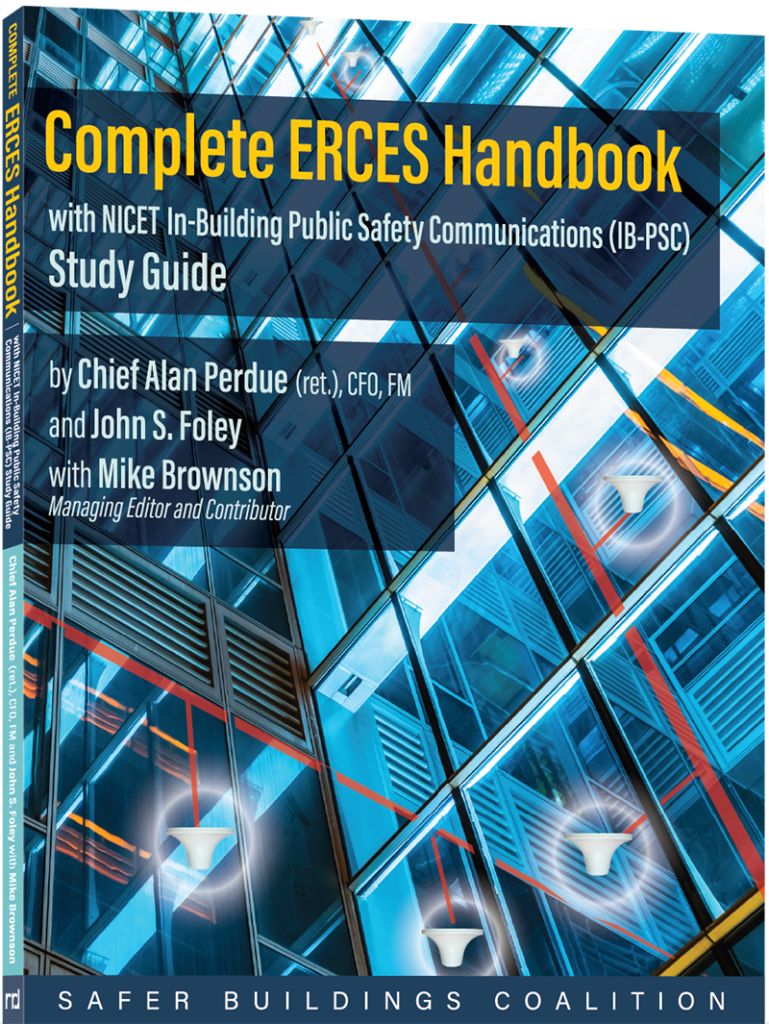
GET THE COMPLETE ERCES HANDBOOK »
An Introduction to In-Building Emergency Responder Communications
When a fire company advances up an exit stairwell, a police officer clears a parking garage, or an EMT works a call in a basement mechanical room, one tool has to work every time: the radio in their hand. Modern buildings — with their concrete cores, low-emissivity glass, insulated metal decking, and deep footprints — do a very good job of blocking the outdoor radio frequency (RF) signals that first responders rely on. The result is a wireless “dead zone” inside the building at exactly the moment the responder needs the signal most.
An Emergency Responder Communications Enhancement System (ERCES) is the code-mandated solution to that problem. This primer explains what an ERCES is, why the codes require it, who is responsible for it, and how a project moves from an initial building assessment to a signed-off, monitored system. It is written for building owners, developers and managers; for AHJs and frequency license holders; and for the specialty contractors who design, install, and maintain these systems.
The primer draws on the Complete ERCES Handbook with NICET In-Building Public Safety Communications (IB-PSC) Study Guide published by the Safer Buildings Coalition. For the authoritative, current-edition-by-current-edition breakdown of every code section referenced below, see the SBC Quick Code Reference, which is updated as editions change.
On this page
- What Is an ERCES?
- Why It Is Needed
- When Is It Mandatory? Codes and Standards
- The Rules: FCC Signal Booster Regulations
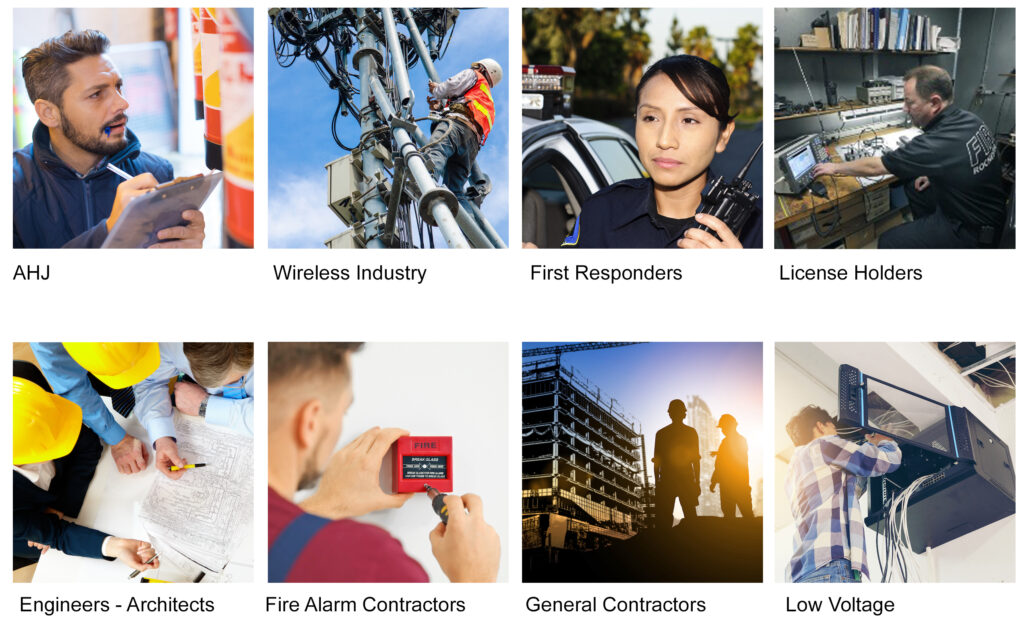
- Who Are the Stakeholders?
- The Project Process, Start to Finish
- Building Owner Considerations
- Cellular Services and the Future of Public Safety
- Competency, Consistency, and the NICET Program
- Conclusion
What Is an ERCES?
An In-Building Emergency Responder Communications Enhancement System (ERCES) is a wireless communications system used by first-responder and emergency-services personnel — police, fire, EMS, homeland security, and disaster-response agencies — to maintain reliable, interoperable, continuous communications inside a building.
The core technical challenge an ERCES solves is straightforward. Public safety radio networks are engineered to cover geographic areas from a set of outdoor tower sites. When a responder walks into a building, RF energy from those towers is absorbed and reflected by the building’s construction. Deeper into the structure — in stairwells, elevators, basements, back-of-house corridors, garages — the outdoor signal simply is not strong enough for a portable radio to talk back out. An ERCES captures a usable signal at the roof, cleans it, amplifies it, and redistributes it through the building via a Distributed Antenna System (DAS), and it does the same in reverse for the responder’s transmissions going out. A network of indoor antennas, placed by design and not by convenience, gets the signal into the places responders actually go.
Two important shifts in language over the past decade are worth noting.
First, “fire department communications” has become “emergency services department communications.” Model codes and standards now cover all responding agencies, not just fire. That matters because roughly 70 percent of 9-1-1 dispatches go to law enforcement, 17–20 percent to EMS, and 10 percent or fewer to fire. The primer’s audience is broader than it used to be, and so are the systems it describes.
Second, “Two-Way Radio Communication Enhancement System” and “ERRCS” have been replaced in the newer code editions by ERCES. The change is deliberate. First responders no longer rely on land mobile radio (LMR) alone. Smartphones, connected tablets, ruggedized laptops, body cameras, and FirstNet devices are now part of the responder’s toolkit, and the codes have opened up to reflect that. When the AHJ specifies “all radio frequencies as required by the AHJ, and any modulation technology in current use by the public safety agencies in the jurisdiction,” they mean it broadly.
Why It Is Needed
Three trends have made the in-building coverage problem worse, not better, over the past twenty years.
Energy-efficient construction blocks RF. Low-emissivity (“low-E”) glass carries a micro-thin metallic coating that reflects heat and ultraviolet light. It also reflects radio waves — a double-pane low-E window can attenuate an 860 MHz signal by 23 to 38 dB. An eight-inch concrete wall attenuates the same signal by roughly 23 dB, absorbing over 99 percent of the RF energy that strikes it. Insulated metal panels, spray-foam insulation with foil backing, LEED-driven construction assemblies, and even metallic solar-control films all contribute. The more energy-efficient a building becomes, the more hostile it is to RF.
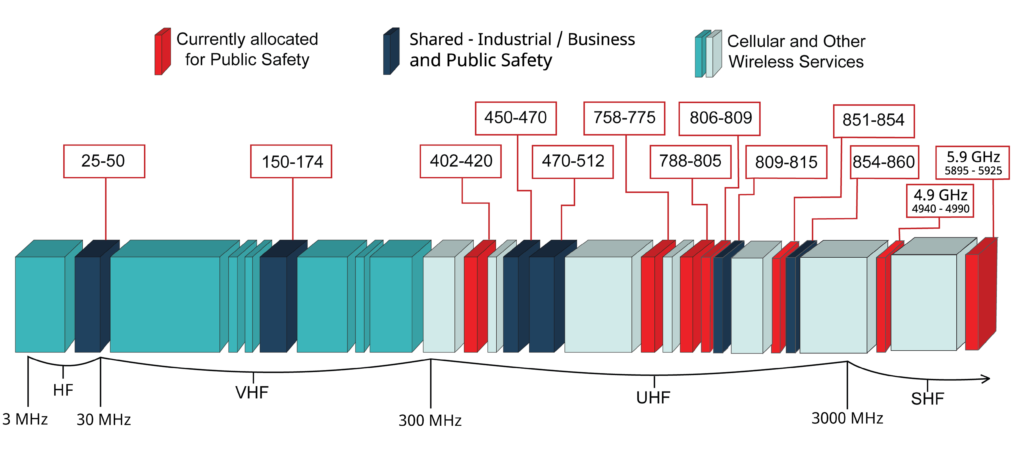
Public safety has moved to higher frequencies. Higher frequencies attenuate faster through building materials. LMR has been migrating up the spectrum for decades — 150 MHz to 450 MHz to 700 MHz to 800 MHz — and 4.9 GHz and cellular millimeter-wave bands are now in play for adjacent public safety uses. The physics do not change: higher frequencies pay a larger penalty at every wall.
Mobile 9-1-1 is now the norm. The National Emergency Number Association reports that roughly 80 percent of calls to 9-1-1 come from mobile devices, and roughly 80 percent of mobile-originated calls either originate or terminate inside a building. The public expects to be able to reach 9-1-1 from anywhere they can reach the elevator button. The FCC has estimated that a one-minute improvement in 9-1-1 response times would save 10,000 lives per year in the United States.
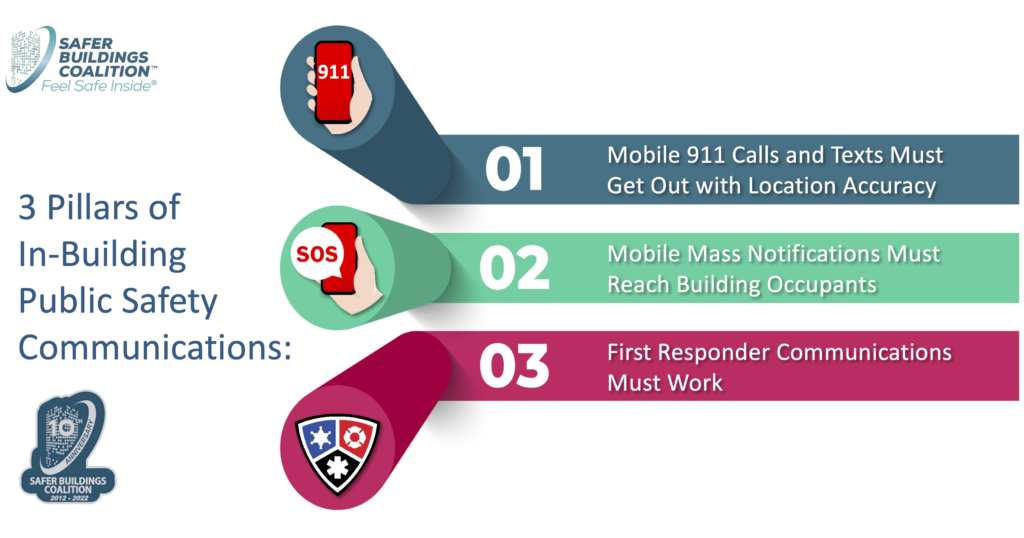
The Safer Buildings Coalition organizes this around three “pillars” of in-building public safety communications: (1) mobile 9-1-1 calls and texts must get out with accurate location; (2) mobile mass notifications must reach building occupants; and (3) first responder communications must work. All three pillars require the same underlying thing — that RF energy can get in, get out, and be usable when it arrives.
When Is It Mandatory? Codes and Standards
Fire and building codes require adequate emergency responder radio coverage inside buildings. If a building has adequate coverage on its own — verified by testing — no ERCES is required. If it does not, one is.
The requirement traces back to 2009, when in-building radio coverage first appeared in NFPA 1 (annex O) and the International Fire Code (IFC Chapter 5, appendix J). Since then, both model-code streams have matured significantly.
Today, the primary references are:
- International Fire Code (IFC), Section 510, with the current adopted edition varying by jurisdiction. IFC 2024 is the current published edition; IFC 2027 is pending.
- NFPA 1, Fire Code, Section 11.10 — the “you must have coverage” performance requirement.
- NFPA 1225, Standard for Emergency Services Communications Systems, Chapter 18 — the “how to install, test, and maintain” requirements. NFPA 1225 (2022) consolidated and replaced NFPA 1221 (2016 and 2019 editions). NFPA 1225-2027 is pending.
- NFPA 72, National Fire Alarm and Signaling Code — for fire-alarm monitoring of the ERCES.
- NFPA 780, Standard for the Installation of Lightning Protection Systems — referenced for donor-antenna lightning protection.
- NFPA 70 (NEC) — for electrical work and, in the newer edition, Article 820 for antenna discharge units.
- UL 2524, Standard for In-Building 2-Way Emergency Radio Communication Enhancement Systems — the equipment listing standard referenced by IFC 2021 and 2024 for active components.
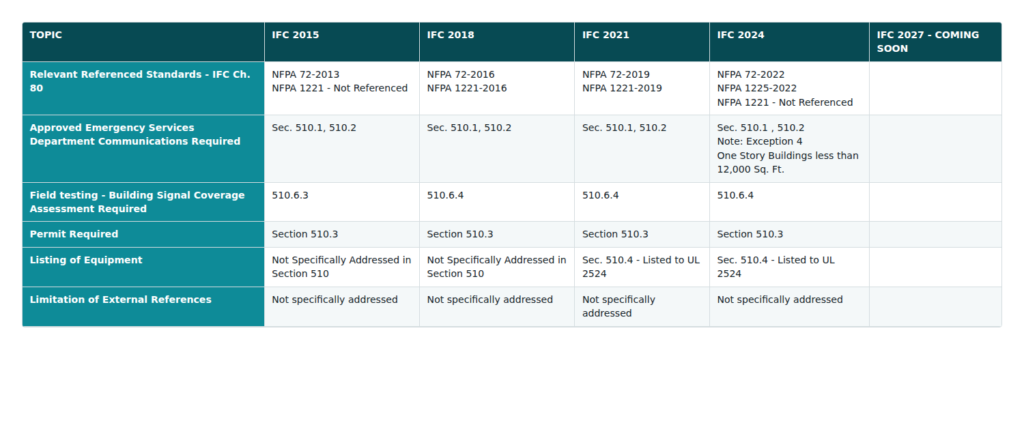
Because adopted editions vary — sometimes by state, sometimes by county or city, sometimes by year — the SBC Quick Code Reference is the single best place to check what actually applies, section by section, across IFC 2015 through 2024 and NFPA 72-2013 through NFPA 1225-2022 (with the 2027 columns reserved for the pending editions). Every citation in this primer has been validated against that reference.
See the current, side-by-side comparison here: SBC Quick Code Reference.
Codes versus standards — and why the difference matters
A code is a legal document, adopted by a jurisdiction through the legislative process, that tells you what must be done. A standard tells you how to do it. Standards become enforceable when they are referenced by an adopted code, or when they are adopted individually. IFC Section 510 tells you that emergency responder communication coverage is required; NFPA 1225 tells you how to design, install, test, and maintain the system that provides it.
Local jurisdictions can — and do — modify model codes when they adopt them. New York City’s Auxiliary Radio Communication System (ARCS) requirements for new high-rises are a well-known example. Some states exclude existing buildings from ERCES enforcement unless there is a major renovation, addition, or change of occupancy; others (Florida and Ohio among them) enforce on existing buildings. Nothing substitutes for asking the local AHJ what edition they enforce and what local amendments apply.
Key technical requirements in the current codes
Working from IFC 2024 and NFPA 1225-2022, the recurring technical requirements include:
- Coverage: DAQ 3.0 (Delivered Audio Quality) across 95% of general building area and 99% of critical areas — command centers, fire pump rooms, exit stairs, exit passageways, elevators and elevator lobbies, and any area the AHJ designates.
- Signal strength: Many designers still work to a −95 dBm design perimeter; DAQ 3.0 is the code-referenced performance metric.
- Donor antenna isolation: 20 dB above system gain.
- Standby power: 12 hours from batteries, or 2-hour batteries plus an emergency generator sized for 100% of the ERCES load.
- Enclosures: NEMA 4 / NEMA 4X for active equipment; NEMA 3R for vented battery cabinets.
- Fire alarm monitoring: All ERCES malfunctions — donor-antenna failure, active-component failure, low-battery (at 70% depletion), loss of AC, charger failure, link failure — are annunciated by the fire alarm system per NFPA 72. A dedicated annunciator is required in the fire command center where one exists.
- Pathway survivability: Backbone cable is routed through an enclosure matching the building’s fire rating, referring back to NFPA 1225 §18.12.3.1 and related sections.
- Testing: Acceptance testing at installation, annual testing thereafter, and a full quantitative re-test at least every five years per NFPA 1225 §20.3.10.2.3.3.
- Frequency license holder approval: Required under FCC Part 90.219 and echoed in the code (NFPA 1225 §18.2.1, §18.7, §18.12.1.1; IFC 2024 §510.5.2 and §510.5.5).
The Rules: FCC Signal Booster Regulations
Codes are only part of the story. The FCC regulates the RF spectrum itself, and its rules govern every ERCES that touches licensed frequencies — which is to say, all of them.
The two relevant sections are:
- 47 CFR § 90.219 — Use of Signal Boosters in the Private Land Mobile Radio Services (PLMRS). This is the primary rule that governs BDAs used to enhance public safety LMR frequencies, including FirstNet Band 14 (which is FCC Part 90 spectrum).
- 47 CFR § 20.21 — Signal Boosters in the Commercial Mobile Services. This governs boosters used with cellular services, and distinguishes between “Consumer” and “Industrial” signal boosters.
Four principles carry through both rulesets:
- Signal boosters may be used in weak-signal areas only. A blanket ordinance that requires a system in every building — regardless of whether the building has adequate coverage — runs counter to this. Testing first, installing second, is the FCC’s expectation.
- The frequency license holder is the only authority who can permit rebroadcast of their licensed frequencies, and that permission must be in writing. Non-licensees — a building owner, a system integrator, a contractor — must obtain the express, recordable consent of every licensee whose frequencies the system will amplify. This is not paperwork. If the FCC investigates interference, the retransmission authorization is what the building owner will need to produce.
- The license holder must maintain a reasonable level of control over the operation of the system in order to resolve interference. In practice, that is why the AHJ, the licensee, and the integrator all need to sit at the same table before any equipment is energized.
- The rules define specific engineering limits. Radiated power is capped at 5 watts ERP per retransmitted channel. Noise figure must not exceed 9 dB. Radiated noise inside the band is limited to −43 dBm in a 10 kHz measurement bandwidth, and −70 dBm outside the band. Class B signal boosters must be registered in the FCC signal booster database at fcc.gov/signal-boosters/registration.
The AHJ has the authority to require public safety coverage in a building. The AHJ does not have the authority to permit rebroadcast on someone else’s licensed frequencies. Only the frequency license holder can do that. This distinction — that the licensee is, in effect, “the other AHJ” — is the most common single source of trouble on ERCES projects.
Who Are the Stakeholders?
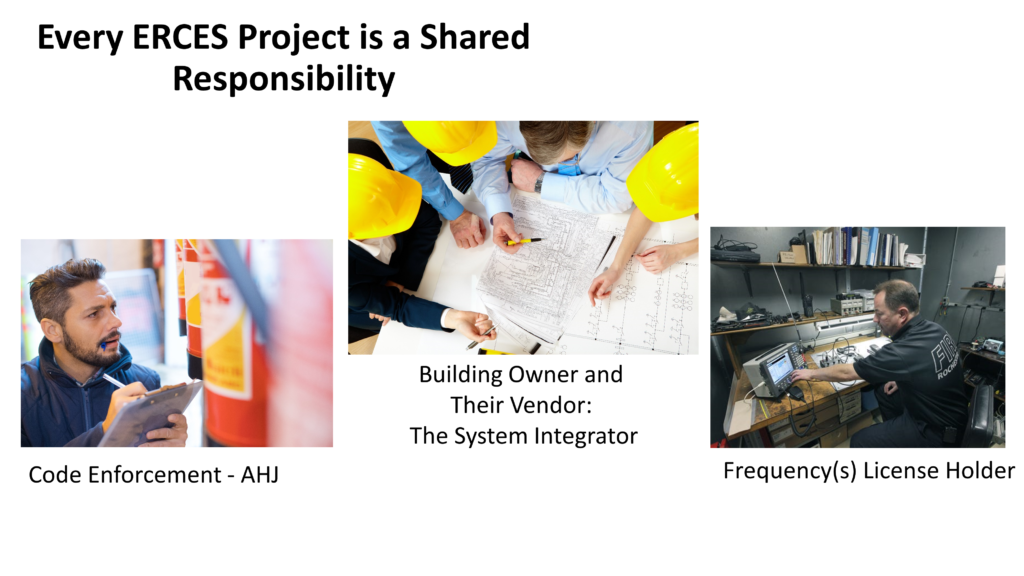
The number-one obstacle to a successful ERCES project, in the Safer Buildings Coalition’s assessment, is stakeholders not being on the same page. There are more parties involved than most first-time projects anticipate, and each has a specific role that the others need to understand.
First responders and the communities they protect. The ultimate users. Everything else exists to make sure their radios work.
Authority Having Jurisdiction (AHJ). The organization, office, or individual responsible for enforcing the code — a Fire Marshal, Fire Code Inspector, Building Inspector, or a Fire Code Official as IFC calls the role. The AHJ reviews plans, issues permits, inspects installations, witnesses acceptance testing, and signs off the Certificate of Occupancy.
Frequency License Holder — the “other” AHJ. The organization that holds the FCC license for the frequencies the ERCES will rebroadcast. For LMR public safety, this is usually the jurisdiction’s radio-system owner, radio administrator, or radio shop. For cellular services, it is the wireless carrier. The license holder must give written consent before any rebroadcast, including for testing, and must maintain enough control over deployed systems to resolve interference. The AHJ should provide the license holder’s contact information to the system integrator — that is now specified in NFPA 1225 §18.15.4.
Federal Communications Commission (FCC). The federal authority. Sets the rules that both the license holder and the system integrator must follow. Issues violation notices when things go wrong.
Model code organizations. The International Code Council (ICC), which publishes the IFC and IBC, and the National Fire Protection Association (NFPA), which publishes NFPA 1, 70, 72, 780, and 1225. Anyone — including you — can participate in their code-development processes.
Building owner, developer, or property manager. The party legally responsible for compliance. In most cases, the party paying for the system. Also, under FCC rules, the party who receives a violation notice if the system causes interference — even though the owner may have no RF expertise and relies entirely on the system integrator. This is why a maintenance contract matters.
System integrator / specialty contractor. The firm that designs, installs, commissions, and often maintains the ERCES. Increasingly a licensed low-voltage or fire-alarm contractor with NICET In-Building Public Safety Communications certification and appropriate manufacturer training. A qualified integrator brings program management, technical, and regulatory expertise together in one team.
Designers, consultants, and Professional Engineers. RF-literate design firms and, in some jurisdictions, PEs who stamp submittals. A note on PE stamps: unless a specific PE has real education and experience in RF design, a PE stamp on an ERCES submittal serves little technical purpose. NICET IB-PSC certification is the emerging alternative, following the same path NICET certifications took for fire alarm and water-based fire suppression.
Architects, engineers, and general contractors. The teams whose design decisions set the ceiling on what an ERCES can be asked to do. Cable pathways, riser space, dedicated electrical circuits, roof access, and NEMA-rated wall space for equipment should all be considered in the initial design — well before the walls close.
OEMs, distributors, testing organizations, and industry associations. The Safer Buildings Coalition and its members work across all of these categories.
The Project Process, Start to Finish
An ERCES project has an administrative track — how the jurisdiction manages, approves, and documents the project — and a technical track — how the system integrator deploys the system in the property. Both tracks run in parallel and must stay coordinated.
From the system integrator’s perspective, a typical project moves through these steps:
- Contact the AHJ and the frequency license holder(s). Gather requirements: the frequency list, the adopted code edition, technical criteria, and any local amendments.
- Review construction documents. Understand equipment locations, cable pathways, wall assemblies, and potential impairments to RF propagation.
- Initial building coverage assessment. Baseline RF testing — indoor and outdoor — to determine whether a solution is even required. Combined with a preliminary physical walk-through of the site.
- Preliminary design. Initial system layout and bill of materials for a quote.
- Statement of work. Written scope and requirements.
- RF survey. Detailed signal-strength measurements once the structure is closed in.
- Update design. Revise the preliminary design and BOM based on the RF-survey results.
- Pre-installation survey. Installer walk-through to validate cable routes and equipment locations against the updated design.
- Final design. Incorporate any changes discovered in the pre-installation survey.
- Permits, plan review, and Provisional Retransmission Authorization from the license holder to allow installation and testing.
- Order equipment following AHJ approval.
- Installation. Stage materials, install cables, antennas, and active equipment.
- Commissioning and optimization. Verify RF performance, set system gains, test.
- System acceptance. Validate compliance with the requirements; AHJ inspection and approval; FCC signal-booster database registration for Class B systems.
- Final Retransmission Agreement from the frequency license holder.
- Maintenance agreement. Ongoing monitoring, periodic testing, and — at minimum — a full quantitative retest at least every five years.
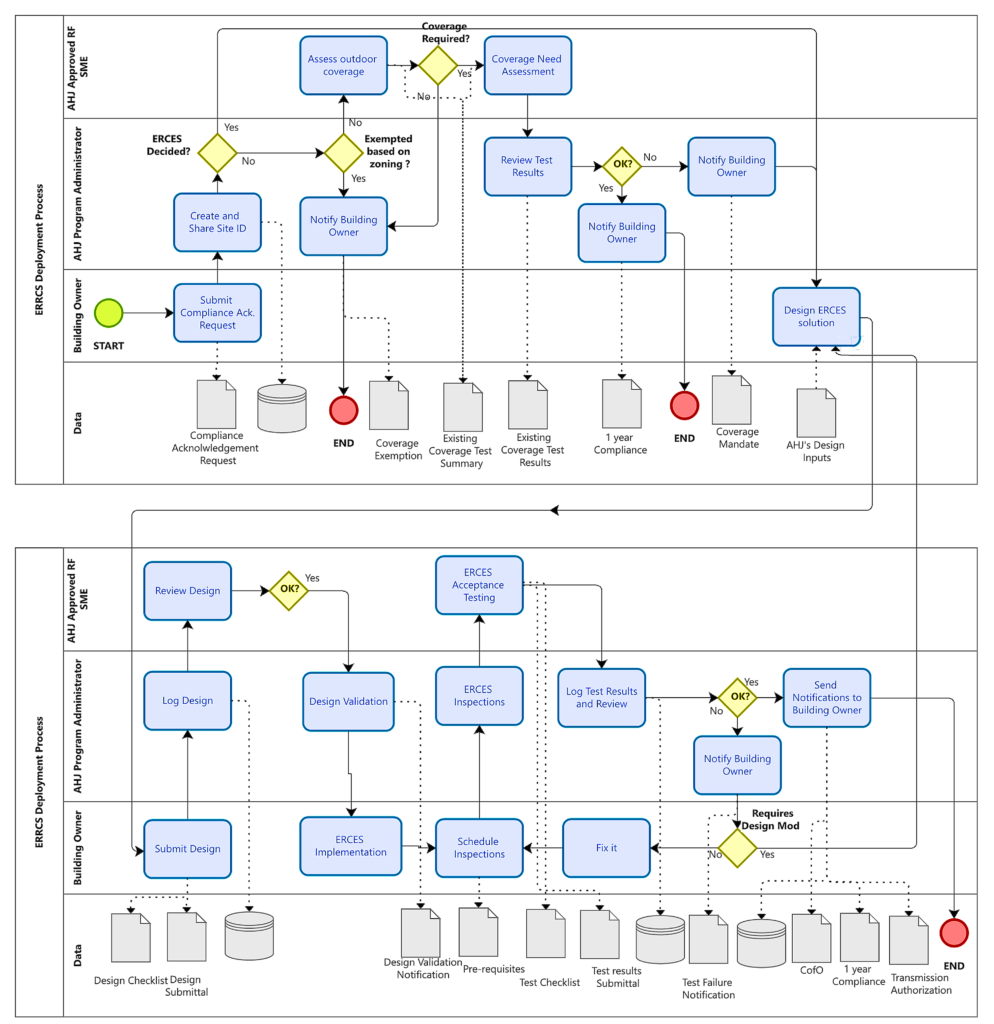
Two structural points about the process matter more than any single step.
An ERCES design cannot be finalized until the building is substantially complete. RF measurements taken in the actual built environment are what allow a designer to finalize the layout. An empty parking garage tests differently than a full one. A warehouse full of racking and product tests differently than an empty shell. A commercial floor full of people tests differently than one that is empty. Some jurisdictions bridge this with a Temporary Certificate of Occupancy that requires a re-test once the building reaches its intended use.
Pathway, power, and space should be reserved early — even before a solution is known to be required. Conduit, riser space, floor cores, wall space, dedicated electrical circuits: all of these are inexpensive to include in the initial design and painful to add after ceilings close. If it turns out an ERCES is not required, the reserved space can be repurposed. If one is required, the pathway is already there.
Building Owner Considerations
ERCES compliance falls squarely on the building owner. It is one of the newest and most consequential compliance elements in the modern fire and building codes, and it does not become anyone else’s responsibility by default. This section distills what the Safer Buildings Coalition’s Building Owners’ Toolkit covers in depth.
The costliest single mistake in this space is discovering the requirement late. A building whose ERCES is designed and installed after ceilings, walls, and finishes are in place will spend materially more than one where the pathway was reserved early. Add supply-chain lead times, AHJ testing and filing requirements, and possible re-work in occupied space, and the ribbon-cutting can move months to the right. A building owner who has the information before construction begins avoids essentially all of this.
Six essential recommendations for building owners
- Find out the current code requirements in your building’s jurisdiction. Adopted editions vary; local amendments matter. Ask the AHJ.
- Select a qualified system integrator partner. Look for NICET In-Building Public Safety Communications certification, at least five years of ERCES experience, GROL where applicable, predictive RF design software certification (iBwave or equivalent), and manufacturer certifications for the equipment they intend to use.
- Do a baseline RF assessment of your building. Know where you stand. If coverage is already adequate, no ERCES is required. If it is not, you now know the shape of the problem.
- Consider future development of the site. New buildings, additions, or changes of occupancy can trigger new requirements — or, done thoughtfully, allow shared infrastructure across a campus.
- For new construction, plan the infrastructure early. Designate cable pathways, riser space, dedicated electrical capacity, and NEMA-rated wall space for equipment. Follow the “Pull Once, Enable Many” (POEM) principle so the same pathway serves ERCES, cellular DAS, IoT, and whatever the next wireless generation brings.
- Obtain written authorization from the relevant FCC license holder(s) for every frequency in the system — before energizing anything, including test transmissions. Failure to do so exposes the building owner to FCC enforcement action, including forfeitures that can exceed $100,000 per continuing violation.
Five questions every property stakeholder should be able to answer
- Can first responders communicate inside your building(s)?
- Can your employees and customers in your building(s) reach and clearly communicate with 9-1-1 on their cell phones?
- Do you have a mass-notification emergency system that actually reaches occupants indoors?
- Do you have a disaster-recovery program for your property(s)?
- Do you have a “smart building” strategy for energy, communications, security, and life safety?
The Safer Buildings Coalition has published a comprehensive Building Owners’ Toolkit covering these questions in depth, along with system-integrator qualification checklists, wireless-infrastructure master planning guidance, and myths, truths, and best practices. Enterprise property stakeholders — owners, developers, and operators — can access it at no cost.
DOWNLOAD THE BUILDING OWNERS’ TOOLKIT »
Cellular Services and the Future of Public Safety
Public safety has relied on LMR voice communications for decades. Over the past ten years, data communications delivered over cellular have become an essential complement — expanding situational awareness through video, mapping, database lookups, building-management information, and other data feeds. In a 2018 SBC survey of the International Association of Fire Chiefs, 76 percent of respondents reported using cellular to be alerted to or respond to incidents, and 67 percent reported using cellular while performing duties during emergency incidents. Those numbers were captured before FirstNet reached widespread deployment. They have only grown since.
The current codes have caught up. Beginning with NFPA 1225 (2022) and IFC 2024, the code explicitly recognizes cellular services as within scope where the public safety agencies in the jurisdiction use them. NFPA 1225 §18.11 requires that the system be capable of transmitting all radio frequencies as required by the AHJ, and be capable of using any modulation technology in current use by the public safety agencies in the jurisdiction — including LTE and 5G. IFC 2024 §510.4.2.6 and §510.6.2 reach the same result, referencing NFPA 1225.
FirstNet — the Nationwide Public Safety Broadband Network — is now a mainstream tool. Established by the Middle-Class Tax Relief and Job Creation Act of 2012 with $7 billion in funding and 20 MHz of dedicated spectrum, FirstNet was awarded to AT&T in 2017 and is now used by more than 24,000 public safety agencies across more than 2.8 million square miles of coverage. FirstNet occupies two 10-MHz blocks of Band 14 spectrum (758–768 MHz downlink and 788–798 MHz uplink), interleaved with narrowband public safety allocations in the upper 700 band. Because Band 14 is FCC Part 90 spectrum, the same signal-booster rules that govern LMR apply to FirstNet.
Shared and combined DAS deployments are possible, with care. A single passive cable network can carry both cellular and public safety, and the head-end fiber infrastructure can be shared even where the active equipment must stay separate to meet the ERCES hardening and battery-backup requirements. Adjacent-band interference — for example, between 700-band FirstNet and public safety narrowband, or between the 800 public safety downlink and the cell 800 uplink — has to be managed with proper filtering. The designer needs to plan for this up front.
Different networks, different metrics. A −95 dBm signal that delivers DAQ 5.0 on a P25 radio can be nearly unusable on an LTE network, where RSRP, RSRQ, SINR, and RSSI are the relevant measurements. A system integrator moving into the cellular DAS space brings a substantial second set of skills and test equipment.
The direction of travel is clear. Public safety communications will remain a mix of LMR and cellular for the foreseeable future, with new bands (CBRS, 5G, whatever follows) folding in as they become operationally significant to responders. The codes have deliberately become technology-agnostic to keep pace. Buildings — and building infrastructure — should be planned the same way.
Competency, Consistency, and the NICET Program
ERCES is a life-safety system. When it fails at the wrong moment, the consequences fall on first responders and the people they are trying to save. The Safer Buildings Coalition’s position is that competency in this workforce cannot be assumed and cannot be self-declared.
The historical qualifications for ERCES personnel — an FCC General Radiotelephone Operator’s License (GROL), manufacturer training, or “adequate skills and experience satisfactory to the AHJ” — do not, on their own, guarantee competency in in-building RF design and deployment. The GROL was designed for aviation and maritime radiotelephone work, and its examination contains no ERCES-specific content. Manufacturer training is important but scoped to specific products. That left AHJs to develop their own qualification concepts, of varying rigor.
The NICET In-Building Public Safety Communications (IB-PSC) certification program, developed by the National Institute for Certification in Engineering Technologies in partnership with the Safer Buildings Coalition, closes that gap. Launched in 2022 under ANAB ISO/IEC 17024 accreditation, it covers four credential levels — Technician I, II, III, and Design — with each requiring a combination of a written knowledge exam, employer-attested performance measures, and documented work history. NICET IB-PSC certification is now referenced in the annex of NFPA 1225-2022 as an appropriate way for a frequency license holder or AHJ to evaluate an RF system designer’s competency.
The certification path is already well established in adjacent life-safety systems. More than 30 states require at least one NICET Level 4 Water-Based Systems Layout certified technician to submit sprinkler-system designs. Fire alarm designers and inspectors follow a similar path. ERCES is now catching up to that norm.
Conclusion
The communications lifecycle begins the moment someone calls 9-1-1 and continues until the last responder leaves the scene. A break anywhere in that chain — a call that cannot be placed from a basement, a mass-notification alert that never reaches an occupant, a firefighter on the twentieth floor whose radio cannot reach the fire command center in the lobby — degrades both public safety and the public’s safety.
An ERCES is one part of that chain, and it is the part that lives inside the building. Getting it right requires the AHJ, the frequency license holder, the building owner, the design team, and a competent system integrator to work as one team, informed by the current codes and by the FCC rules that sit alongside them. The Safer Buildings Coalition exists to make that coordination easier — through the Complete ERCES Handbook, the SBC Quick Code Reference, the Building Owners’ Toolkit, the seminar and webinar programs, and the SBC membership.
In-building communications will continue to evolve. New technologies, new frequency bands, and new use cases will appear. What will not change is the underlying reason we build these systems: so that when someone inside a building needs help, everyone who might come to their aid can talk to each other, reliably, every time.
This primer draws on the Complete ERCES Handbook with NICET In-Building Public Safety Communications (IB-PSC) Study Guide, by Chief Alan Perdue (ret.), CFO, FM and John S. Foley, with Mike Brownson. © Safer Buildings Coalition. All rights reserved.